Global Regulatory Patchworks and Their Mark on Algorithm Development for Casino Software Suites

Regulatory frameworks differ sharply across jurisdictions, and these differences directly shape the algorithms that power casino software suites. Developers must adapt random number generators, bonus mechanics, and compliance modules to meet local rules that rarely align. In June 2026 several Asian markets introduced updated technical standards that required fresh certification cycles for existing RNG cores, while North American operators adjusted their systems to accommodate revised payout verification protocols.
Regional Regulatory Differences Drive Algorithmic Adjustments
European nations outside the UK maintain distinct testing regimes through bodies such as the Malta Gaming Authority and the Swedish Gambling Authority, each imposing unique audit frequencies and statistical thresholds on game outcomes. These requirements force software teams to maintain multiple RNG variants rather than a single universal engine. Observers note that developers often segment their codebases by jurisdiction, storing separate parameter sets that activate based on player location detected at login.
North American states operate their own certification pathways. The Nevada Gaming Control Board enforces strict continuous monitoring standards that affect how algorithms log and report deviation data in real time. Meanwhile Canadian provincial regulators emphasize player limit algorithms that cap session lengths through dynamic difficulty scaling. Software suites therefore embed configurable compliance layers that switch behavior when a player crosses provincial boundaries.
RNG Certification and Technical Implementation
Random number generator algorithms undergo separate validation processes depending on the target market. Australian regulators require extensive diehard and NIST statistical test batteries plus additional entropy source audits that exceed many other jurisdictions. Developers respond by building modular RNG wrappers that can swap statistical post-processing filters without altering the core generator. This modular approach allows the same underlying Mersenne Twister or cryptographic primitive to satisfy both Australian and North American requirements through different output conditioning stages.
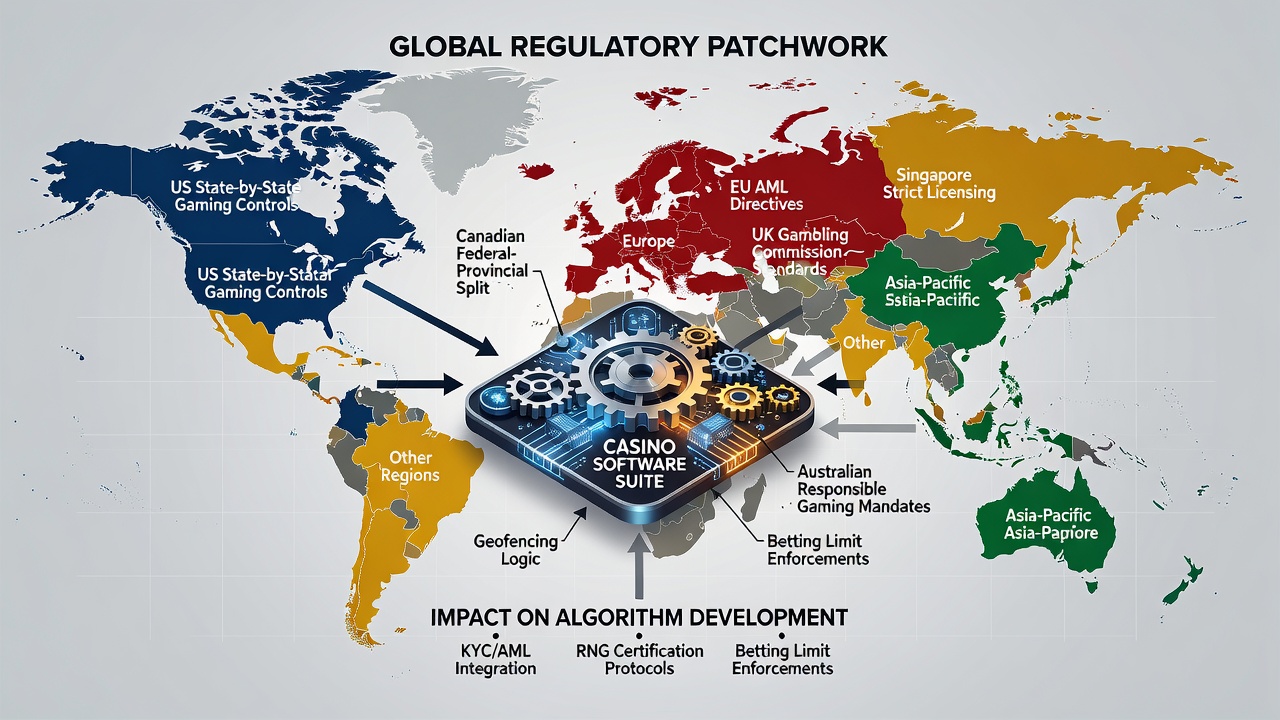
Asian markets add another dimension. Singapore's Casino Regulatory Authority focuses on return-to-player calculation transparency, requiring algorithms to expose theoretical RTP values through auditable configuration files. Macau authorities emphasize anti-money laundering triggers that integrate directly into bet sizing algorithms, automatically flagging patterns that exceed defined thresholds. Software teams therefore embed regulatory flags within the same decision trees that determine bonus eligibility, creating tight coupling between compliance logic and game mathematics.
Player Protection Algorithms Across Borders
Responsible gaming features reveal further fragmentation. Some jurisdictions mandate time-based session reminders delivered through algorithmic triggers, while others require loss-limit enforcement calculated on a rolling 24-hour window. Developers address these variations by maintaining rule engines that accept jurisdiction-specific parameters at runtime. The same loyalty tracking module can therefore enforce daily deposit caps in one market and weekly loss thresholds in another without requiring separate software builds.
Data from Nevada Gaming Control Board reports shows that operators updated their session management algorithms multiple times between 2024 and 2026 to accommodate new player self-exclusion synchronization requirements. Similar patterns appear in Australian markets where the Australian Communications and Media Authority tracks integration between gaming algorithms and national exclusion registers.
Development Workflows and Compliance Overhead
Software studios now structure their teams around regulatory clusters rather than traditional game categories. One group focuses on RNG certification pathways, another on responsible gaming logic, and a third on payment and audit trail integration. Version control systems tag every commit with the jurisdictions it affects, allowing automated testing pipelines to run only the relevant compliance suites before deployment.
These workflows reduce duplication while preserving the flexibility required by divergent rules. Research from academic groups studying gaming technology indicates that studios maintaining separate compliance branches experience fewer certification delays compared with those attempting single-codebase solutions across all markets. The reality is that global regulatory patchworks reward modular architecture over monolithic designs.
Conclusion
Global regulatory differences continue to influence how casino software algorithms are designed, tested, and deployed. Developers balance the need for core mathematical consistency against jurisdiction-specific compliance demands through modular systems and configurable rule engines. As markets update their technical standards in 2026 and beyond, these adaptation patterns will likely deepen, shaping the next generation of casino software architecture.